Natural Pools
A defined swimming area, with the water cleaned by a planted regeneration zone beside it.
Discover natural pools
Pools designed for Cambridge homes
Outdoor swimming has a long history in Cambridge, from the university bathing shed reached along Grantchester Meadows to the unheated Jesus Green Lido. A natural pool is unheated too, and its design starts with how you like to swim.
Our team in Bury St Edmunds designs the water and its garden setting at the same time, so planting and paths are drawn up with the pool.
Meet the team behind each designFour types to choose from
Swimming ponds have soft planted edges, while living pools take a crisper, architectural line. We match the type to the size of your garden and your budget.
A defined swimming area, with the water cleaned by a planted regeneration zone beside it.
Discover natural poolsOpen water for swimming, with planted margins and an informal, natural edge.
Discover swimming pondsA modern pool look, with biological filtration set apart from the swimming area.
Discover living poolsA pond for wildlife and native planting, to watch from the garden. It is not for swimming.
Discover wildlife pondsEach price is a guide starting figure and excludes VAT. Quotations reflect size, access, ground and finishes.
Our guide to costs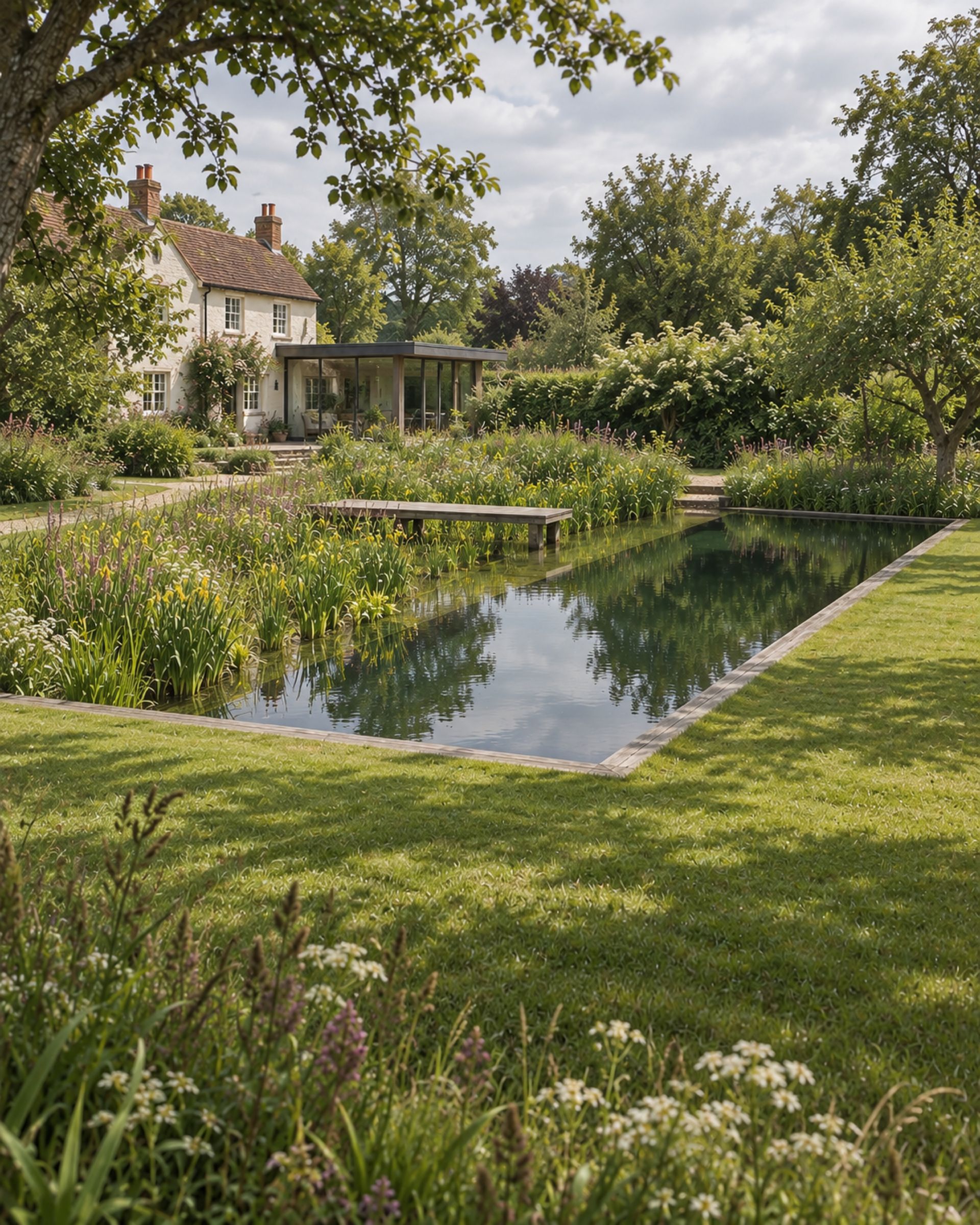 The garden as one design
Reading the site
Chalk lies under south-east Cambridge and the Granta and Rhee valleys, with clay to the north-west and permeable river terrace deposits across much of the city.
Chalk to the south has shallow soils with flint, and peat in the north can compress when groundwater levels change. Both affect construction, so we assess your site first.
We check the route for machinery and where excavated soil will go. The everyday walk between house and pool is planned as well.
Materials should suit the house, whether red-brick Arts and Crafts in West Cambridge or flint and clunch in a chalk village.
How a project begins
You can start with a loose idea. We help you decide what you want from the water and where the pool should sit, then turn that into a design brief.
Point out the trees worth keeping and the views you enjoy from the windows. We then discuss how much swimming space you need and your budget.
Request a consultationDesign visualisations let you see the pool in your garden before you commit. You can then ask for changes to its position, shape or finishes.
How we visualise designsWe build the swimming area, regeneration zone, planting and landscape together, then explain the care the finished pool needs.
See how we buildThere is no charge for the first design consultation and no obligation. Send some photographs of the garden to get started.
Begin with a consultationThe city & South Cambridgeshire villages
Central Cambridge is about 40 minutes from Bury St Edmunds in free-flowing traffic, and we cover the villages around it.
Girton, Histon, Impington, Milton, Horningsea, Oakington, Waterbeach and Cottenham.
Grantchester, Trumpington, Hauxton, Great and Little Shelford, Stapleford, Harston, Sawston and Babraham.
Fen Ditton, Teversham, Stow cum Quy, Fulbourn, Great Wilbraham, Newnham, Coton, Madingley, Barton, Comberton, Hardwick and Haslingfield.
We also cover places further out, such as Linton. Include your postcode when you get in touch.
Natural pools across CambridgeshireAfter the build
Aftercare and servicing continue once the pool is complete. If you already own a chlorine pool, we can assess it for conversion.
Learn the routine care for your water and filtration, including cutting back the planting each autumn.
Caring for your poolSpring and autumn servicing for the pump and air system, with a check on the pool's overall condition.
Servicing explainedExisting chlorine pools are assessed case by case to see whether they could move to biological filtration.
Conversions explainedCommon Cambridge questions
These answers cover planning, ground conditions, water supply and aftercare for a natural pool in and around Cambridge.
All natural pool FAQsName your village or part of the city and describe the garden briefly. We can suggest a pool type if you have not chosen one.
Book a consultationYes. Our base is in Bury St Edmunds, about 29 miles from central Cambridge along the A14 past Newmarket. Our design and build service for natural pools and ponds covers gardens in the city and in the villages of South Cambridgeshire, and every project starts with a free design consultation.
About our team ↗It depends on garden size and how you plan to swim. A swimming pond has planted margins and a softer outline. A natural pool keeps the swimming area and planted zone separate, and a living pool has a more architectural look. Wildlife ponds are for habitat and not for swimming. Photographs and rough dimensions help us suggest a starting point.
Pool types side by side ↗Guide prices start at £45,000 for a swimming pond and £80,000 for a natural pool or a living pool. A wildlife pond, which is not meant for swimming, starts at £12,000. All four figures exclude VAT. Your quotation then depends on size, access and finishes, as well as ground conditions such as clay or groundwater.
Our full cost guide ↗Cambridge City Council and South Cambridgeshire District Council share one planning service, Greater Cambridge Shared Planning. Check early whether your house is listed, sits in a conservation area or lies in the Green Belt outside a village inset. The city has 18 conservation areas and South Cambridgeshire has 85. In these, a pool at the side of a house needs planning permission.
Planning permission guide ↗We investigate both early. Gault Clay usually shrinks and swells in the top 1.5 to 2 metres, and tree roots affect how deep it moves. Parts of Cambridge near the Cam lie in Flood Zones 2 and 3, which the Environment Agency's Flood Map for Planning shows. Work within 8 metres of a main river may need an Environment Agency permit.
Yes. A design visualisation shows the pool as it would appear in your garden, before any work is agreed. It lets you judge the pool beside the house, whether that is gault brick that has weathered to grey or yellow Cambridge stock, and refine the design from there.
About design visualisation ↗Possibly. Each chlorine pool is assessed case by case, starting with its structure, its filtration and whether there is room for a planted regeneration zone. Photographs and a note of the current pump and filter help us say whether a move to biological filtration is realistic.
Read about chlorine pool conversions ↗Yes. After the build we provide maintenance and aftercare support, with servicing visits in spring and autumn that cover the pump and air system. The planting is cut back each autumn. From the start we set out the routine care, so you know what the pool needs through the year.
Our servicing visits ↗Hosepipe restrictions in dry summers can stop a pool being filled from the mains. We plan for rainwater, which also avoids the algae-feeding phosphate often added to mains water. East Anglia averages 627 mm of rain a year against 1,163 mm for the UK, and the Environment Agency classes Cambridge Water's area as seriously water stressed.
Your postcode, photographs of the garden, approximate measurements and a budget are all useful. Tell us if the house is listed or in a conservation area, or if the garden is close to the Cam. The consultation itself is free and carries no obligation, and choosing a pool type can come later.
Book your consultation ↗