Natural Pools
A clearly shaped swimming area beside its own planted regeneration zone, set within a designed garden.
About natural pools
Designed for gardens in Newmarket
Gardens around Newmarket range from town plots behind high brick walls to land backing onto post and rail paddocks. Levels and the outlook from the house help decide where a pool should go and how it should look.
Bury St Edmunds, where we are based, is about 15 miles away, mainly along the A14. We design the pool, its planting and the garden around it as one project.
Get to know the teamPools & ponds we build
All four options are free of chlorine. They differ mainly in how formal they look and how much space the planting needs, and we can help you weigh them up.
A clearly shaped swimming area beside its own planted regeneration zone, set within a designed garden.
About natural poolsRoom to swim among planted margins and natural edging, in a softer and more informal style.
About swimming pondsA modern pool look, with the biological filtration placed outside the swimming area.
About living poolsOpen water and native planting for wildlife, to enjoy from the garden but not to swim in.
About wildlife pondsPrices are starting guides, excluding VAT. Quotes reflect pool size, site access, the ground and chosen finishes.
See the full cost guide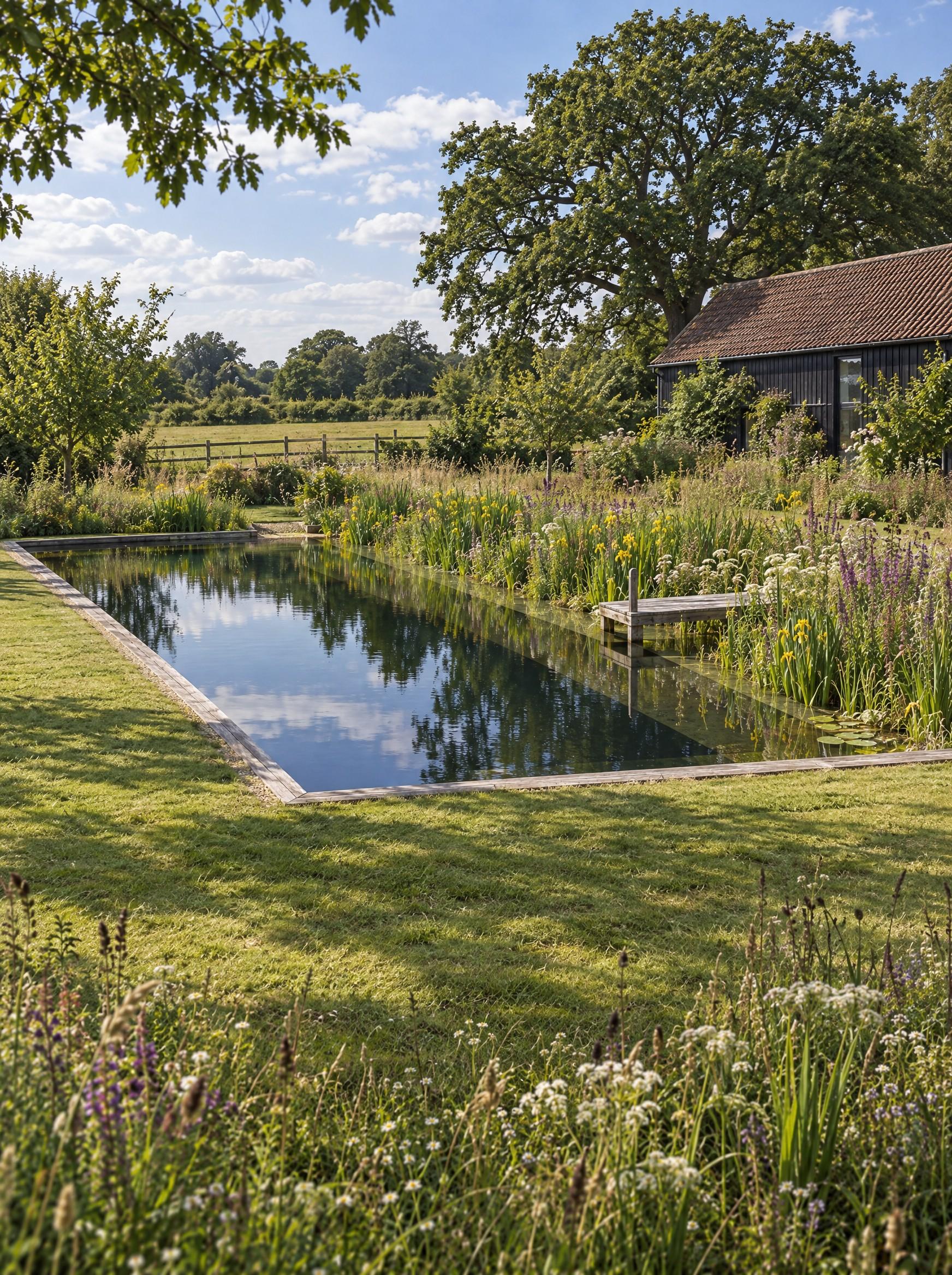 Pool and garden planned together
Starting with your site
Newmarket sits on chalk, among stud paddocks and roads lined with beech shelter belts. Both the ground and the setting affect where a pool can go and how it is built.
Soils over the chalk are often shallow and free-draining, and the Upper Chalk carries flint seams, some of them large. Leaking drains can trigger sinkholes in chalk, so a sealed lining and careful drainage matter.
East Anglia averages about 627 mm of rain a year, just over half the UK average. Hosepipe restrictions can stop mains filling, so we plan around rainwater.
Local red brick, flint and clunch can guide paving and walling, and any listed status or conservation area needs checking early.
How a project begins
Bring whatever you have, from a rough idea to a list of must-haves. We work through the options with you and settle the design in stages.
Tell us what you want to keep, such as a view over paddocks or a beech shelter belt. We talk through your budget and how much swimming space you want.
Book your free consultationA design visualisation places the proposed pool in a view of your own garden, so its size and position can be agreed before you commit.
Design visualisations explainedConstruction follows the agreed design, and we show you how to care for the water and planting afterwards.
See the build stagesYour design consultation costs nothing and carries no obligation. Send a few garden photos and rough measurements to get started.
Request a design consultationNewmarket & the villages around it
Newmarket is in Suffolk, while many of the surrounding villages are in Cambridgeshire. We cover both, from fen-edge Burwell to Moulton on the River Kennett.
Snailwell, Chippenham, Fordham, Freckenham, Kennett, Herringswell, Moulton, Kentford, Higham, Gazeley, Dalham, Cheveley, Ashley and Ousden.
Exning, Burwell, Reach, Swaffham Prior, Swaffham Bulbeck, Bottisham and Six Mile Bottom.
Woodditton, Stetchworth, Saxon Street, Dullingham, Kirtling, Burrough Green, Lidgate, Weston Colville and Cowlinge.
We also cover villages not named here and further west towards Cambridge. Your postcode is enough for a first conversation.
Natural pools across SuffolkLooking after the water
Support carries on after the build, whether you want routine advice or seasonal visits to check the equipment.
See what the water and planting need through the year, including cutting back in autumn.
Read about maintenanceA check of the pump and air system each spring and autumn.
Servicing detailsIf you have a chlorine pool, we can assess whether it could be converted, case by case.
Read about conversionsQuestions about Newmarket gardens
Answers for Newmarket gardens on chalk ground, paddocks, costs and planning on both sides of the county border.
Read the full FAQSend your village or postcode and a line about your plans. Choosing a pool type can wait until we have talked.
Book a consultationYes. We are about 15 miles away in Bury St Edmunds, mainly along the A14. We cover both sides of the county border, from Exning and Moulton in Suffolk to Cheveley and Burwell in Cambridgeshire. Your postcode tells us which council handles planning and whether Anglian Water or Cambridge Water supplies you.
About the team ↗It may, depending on the layout. The swimming area, the planted regeneration zone, equipment and a place to sit all need room. In Newmarket’s conservation area, permitted development for pools does not apply between a side wall and the boundary. The position is worth checking with West Suffolk Council early.
Compare the four types ↗Natural pools and living pools start at £80,000, and swimming ponds at £45,000. Wildlife ponds, which are built for habitat and not for swimming, start at £12,000. All prices exclude VAT. Your quotation follows from the design you choose and the conditions in your own garden.
Our guide to costs ↗It depends where you live. West Suffolk Council covers most of Newmarket and the Suffolk villages. East Cambridgeshire District Council covers the town’s southern suburbs and villages such as Burwell and Cheveley. Greater Cambridge Shared Planning handles Weston Colville and Six Mile Bottom. Newmarket parish has 109 listed building entries and a conservation area, so ask the council early whether either affects your home.
Read our planning guide ↗It affects the design. Chalk lies close to the surface under Newmarket and Moulton. Villages such as Cheveley and Kirtling sit on chalky boulder clay, and Kentford on river terrace sand and gravel. The British Geological Survey notes that chalk is more prone to sinkholes under clay or sand cover, so we assess the ground before settling the construction method.
Yes. Our design visualisations show the proposed pool within your garden. You can judge how it sits against the house and any view out to paddocks or shelter belts. Changes to the position or shape are easier to make at this stage than once work begins.
Read about visualisations ↗Possibly. We assess each pool case by case, looking at the structure and the space around it. On chalk, draining the old pool needs care, because the British Geological Survey lists emptying a swimming pool among documented sinkhole triggers. Photographs and details of the current equipment are a useful first step.
How pool conversions work ↗We offer maintenance and aftercare support, with servicing visits in spring and autumn. Planting is cut back each autumn. We prefer rainwater for topping up, since mains water often carries added phosphate that feeds algae. Collecting rainwater is worth designing in from the start, and West Suffolk’s Local Plan encourages it.
Spring and autumn servicing ↗Possibly. A pool there means extending the garden onto land used for another purpose, which needs planning permission. West Suffolk’s Local Plan allows only small, unobtrusive garden extensions, and East Cambridgeshire’s plan keeps a distinction between gardens and farmland. Land near Devil’s Dyke, a protected chalk grassland site, is also worth raising with the council.
No. There is no charge, and it does not commit you to anything. Useful things to send are your postcode, garden photos, rough measurements and a budget range. Mention anything you already know about the property, such as a listed house, a conservation area, paddock land or drainage problems.
Arrange a free consultation ↗