
Our neighbouring county
A natural pool designed around your Essex home.
Many older houses in north Essex are timber-framed, with colour-washed render and, in places, decorative pargeting. Roofs are often steeply pitched in peg tile or long straw thatch, and some fronts were later refaced in Georgian red brick. We choose the pool’s materials and planting to suit buildings like these.
Our base is in Bury St Edmunds, about 33 miles by road from Colchester and about 36 miles from Saffron Walden. Chelmsford, at about 45 miles, and Brentwood, at about 55 miles, are further. We plan site visits and construction with that travel in mind.
See our Suffolk county pageCompare the options
Choose the pool that suits your garden.
A planted swimming pond often suits an informal rural garden, and a living pool suits a more architectural setting. A natural pool sits between the two. We talk through how you want to swim before recommending one.
Prices shown are guide starting prices and exclude VAT. Your quotation is prepared once the pool size, ground and access are known.
View the cost guide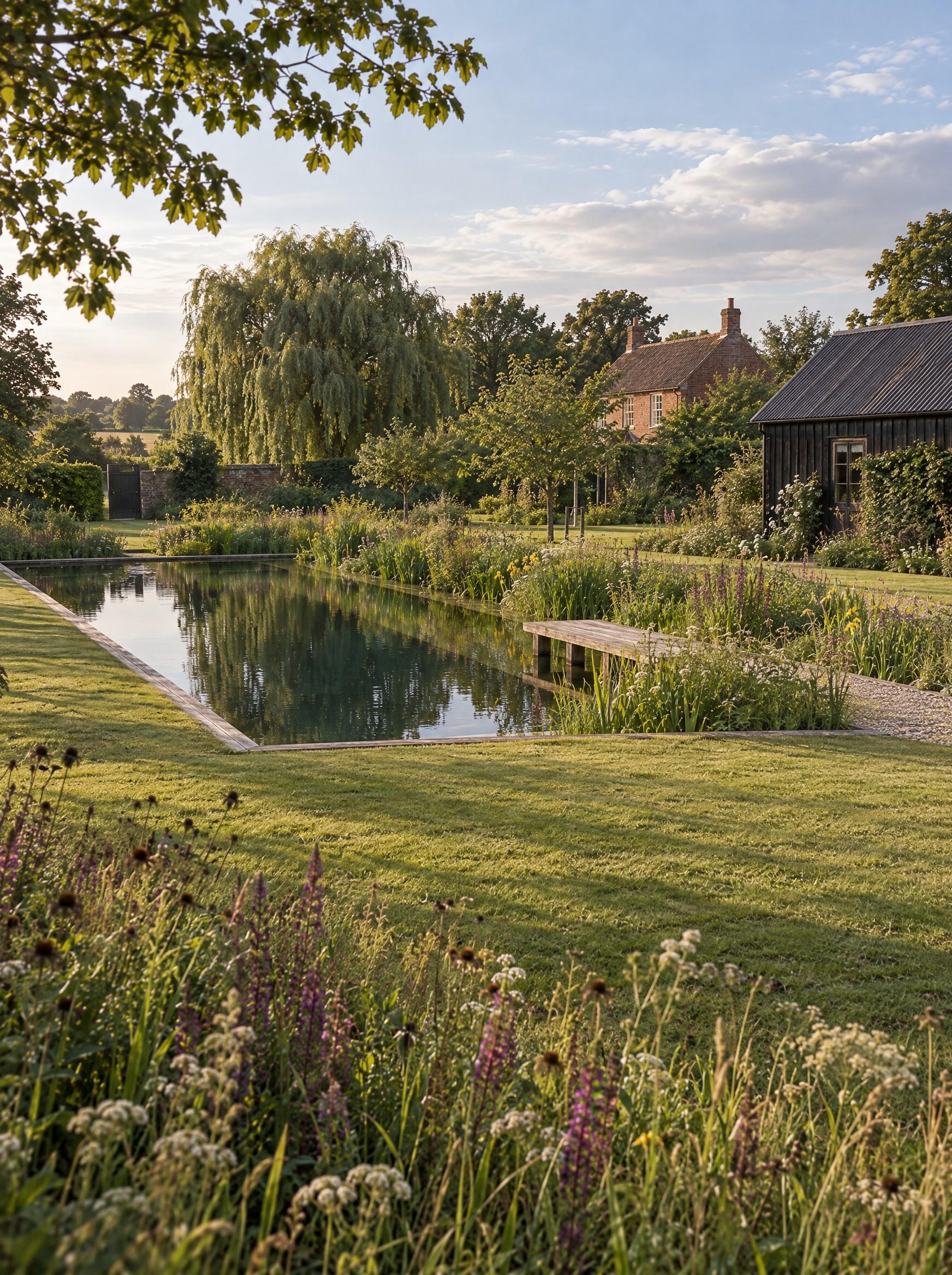
What to check in Essex
The local details that shape an Essex pool.
Essex ground ranges from thin chalk soils in the north-west to London Clay across the south and centre, and planning designations vary between districts. We look at both early, before a pool position or budget is settled.
01
Check the ground first
London Clay can become waterlogged in winter and shrink in summer. Where sand caps the hills at Danbury, Brentwood and Epping Forest, springs rise at its base. We check your plot for both before choosing a construction approach.
02
Plan around mature trees
Tree roots dry out clay and can make it shrink, so the pool’s position relative to mature trees needs care. In a conservation area, most tree work needs six weeks’ notice to the council.
03
Raise designations early
Green Belt covers 89% of Brentwood borough and 92% of Epping Forest district. Listed houses and conservation areas need early checks, and digging close to a main river can need an Environment Agency permit.
From enquiry to build
How we turn your ideas into a buildable design.
Tell us what you want from the water, and we work through the design and the practical questions with you, one stage at a time.
01
Send us the basics
Send photographs, rough measurements and your postcode, which tells us the planning authority and helps us plan a visit. We then talk through styles and budget.
Request a free consultation02
Visualise the design
See the pool, planting and terraces laid out in your own garden before anything is built, so the layout can be adjusted at the design stage.
Explore design visualisation03
Agree scope and timing
We agree the scope, permissions and build sequence, including how the work is scheduled around travel from Bury St Edmunds, with aftercare discussed from the outset.
How a natural pool is builtIf an extension or wider garden redesign is also planned, include the pool from the start. Levels, drainage and spoil removal can then be planned before new paving goes down.
Send us your plansTravelling from Bury St Edmunds
Essex gardens from the Stour valley to Brentwood.
The towns and villages below give a sense of where we work in Essex. We take on natural pool projects in and around each of them.
Colchester and north Essex
Colchester, Dedham, Coggeshall, Halstead, Finchingfield, Thaxted, Great Dunmow and Saffron Walden.
Bury St Edmunds, our baseChelmsford and mid Essex
Chelmsford, Writtle, Great Waltham, Great Baddow, Danbury, Stock, Maldon and Wickham Bishops.
Brentwood and south-west Essex
Brentwood, Shenfield, Hutton, Ingatestone, Doddinghurst, Kelvedon Hatch, Epping, Theydon Bois and Chipping Ongar.
If your town or village is missing from the list, contact us anyway with your postcode and some details of the garden. We will explain how we would approach the project.
Owning a natural pool
Care and servicing after the pool is built.
Natural pools need looking after. Planting is cut back each autumn, and collected rainwater is the better choice for top-ups. We explain the routine and offer spring and autumn servicing visits.
Routine care
Learn the routine your pool needs, including debris removal, equipment checks and looking after the planted zone.
Maintenance and aftercare adviceServicing visits
Arrange spring and autumn servicing, planned around your filtration system and the condition of the pool.
Seasonal servicing detailsConverting a pool
If you have a chlorine pool, we can assess whether its structure and surroundings suit a natural conversion.
Chlorine pool conversionsBefore you get in touch
Answers for Essex homeowners.
Answers on travel from Suffolk, the Green Belt, clay soils and water supply, written for Essex gardens.
Start with a consultationRead the full FAQsDo you travel from Suffolk to work in Essex?
Yes. We work from Bury St Edmunds and cover north, mid and south-west Essex for both design and construction. Colchester and Saffron Walden are the closest, at about 33 and 36 miles by road, while Chelmsford and Brentwood are about 45 and 55 miles away. Site visits and the build programme are planned around that travel. For places outside the areas listed, send a postcode and we can discuss the site.
Read about our Bury St Edmunds baseCould a pool suit a listed timber-framed house?
It can, if the position and materials are chosen with care. Early Essex houses are usually timber-framed, rendered in lime plaster and roofed in plain clay tiles, and Uttlesford alone has around 3,700 listed buildings. A swimming pond or a softly planted natural pool can sit well beside a period house. If the house is listed, permitted development rights do not cover a pool within its curtilage, so involve the local planning authority early.
Compare the four pool typesWhat will a natural pool in Essex cost?
Our published guide prices are from £45,000 for a swimming pond and from £80,000 for a natural pool or a living pool. Wildlife ponds, which have no swimming area, are from £12,000. All prices exclude VAT. Your own design is priced once we know its size, the access and ground conditions, and the finishes you choose.
Read the full cost guideCan I have a natural pool if my home is in the Green Belt?
It depends on the property. Green Belt covers 89% of Brentwood borough and 92% of Epping Forest district. The designation does not in itself restrict householder permitted development for a garden pool. Those rights have limits, such as a pool forward of the principal elevation, and an Article 4 direction or planning condition can remove them. If a full application is needed, the effect on the openness of the Green Belt is assessed. Check the position with Brentwood Borough Council or Epping Forest District Council early.
Read the planning guideCan a natural pool be built on heavy Essex clay?
It needs assessing on your plot. London Clay, common across the south and centre of Essex, becomes waterlogged in winter and cracks and shrinks in summer, particularly where tree roots dry it out. In the north, chalky boulder clay gives heavy, impermeable soils. We check groundwater, drainage and nearby trees, and allow for winter water in the excavation, before recommending how the pool should be built.
Can I see the pool in my own garden before I commit?
Yes. Before you commit, a design visualisation shows the pool in your own garden, with its position and planting. It helps you judge how the materials will look beside a timber-framed house or a weatherboarded barn, and to ask for changes while the design is still open. Site investigations and technical detail are developed alongside it.
How design visualisation worksDoes Dedham Vale or a conservation area change what I can build?
Both can narrow what householder permitted development allows. Dedham Vale National Landscape, which takes in a small part of the Colchester district, is still legally an Area of Outstanding Natural Beauty. There and in conservation areas, those rights do not cover a pool beside the house, between a side wall and the boundary. In the AONB, pools and buildings more than 20 metres from the house may cover no more than 10 square metres in total. Check with the council before the design is settled.
Could you convert our existing chlorine pool?
Some can be. We assess each pool case by case, starting with the shell and its condition. Biological filtration needs room of its own, so the space around the pool matters too. Send photographs of the pool and its equipment, and we can tell you whether a conversion is worth exploring further.
Read about pool conversionsWhere does the pool water come from?
Rainwater, wherever possible. Mains supplies often carry added phosphate, which feeds algae, and hosepipe restrictions in dry summers can stop a pool being filled from the mains. Writtle averages 586mm of rain a year, against 870mm for England, and Essex and Suffolk Water, Anglian Water and Affinity Water are all classed as being in serious water stress. At that rainfall, a 100 square metre roof collects about 55 to 60 cubic metres a year before losses.
Read about maintenance and aftercareWhat is the first step?
Book a free design consultation, which carries no obligation. It helps to share photographs of the garden, its rough size and the budget you have in mind. From your postcode we can tell which council handles planning, from Uttlesford, Braintree and Colchester in the north to Chelmsford and Maldon in mid Essex and Brentwood and Epping Forest in the south-west. Choosing a pool style can wait until we have seen the garden.
Arrange your free design consultation