Natural Pools
A defined swimming area beside a separate planted zone that cleans the water.
View natural pools
For Norwich homes and gardens
Norwich gardens vary from city plots behind brick terraces to larger grounds in the villages and on the Broads edge. We look first at the size and shape of the garden and how the pool will be used.
Water in our pools is cleaned biologically by planting in a regeneration zone, without chlorine. We design that planting as part of the wider garden.
Meet the team in Bury St EdmundsPools & ponds for Norwich
The four types differ in how much of the water is planted and how architectural the edges look. We can help you choose one that fits your garden and budget.
A defined swimming area beside a separate planted zone that cleans the water.
View natural poolsSwimming water set within planted margins, with a looser, more natural outline.
View swimming pondsA modern pool look, with biological filtration separate from the swimming area.
View living poolsNative planting and wildlife habitat, to watch from the house or garden. Not designed for swimming.
View wildlife pondsGuide prices exclude VAT. Each quotation is based on pool size, finishes, site access and ground conditions.
Read about pool costs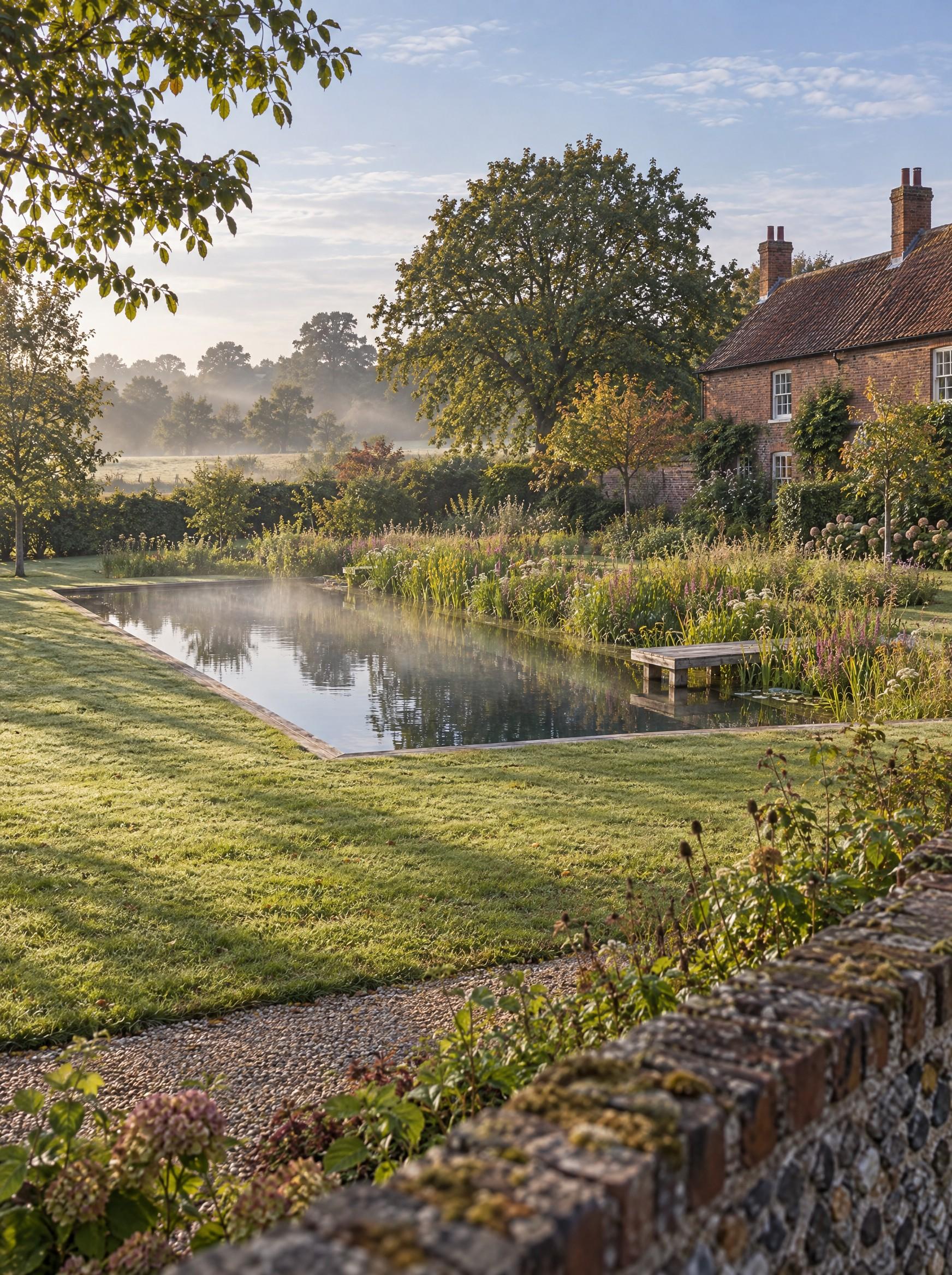 Swimming area and planting together
Local ground and planning
Broadly, chalk lies to the west of Norwich, Crag sands and gravels to the east, till to the south and alluvium and peat in the valleys. We confirm what is under your garden.
Water getting into chalk cavities under parts of the city has caused collapses and subsidence. Poringland and the Framinghams are at risk of groundwater flooding. Both can affect the construction method we recommend.
Machinery and spoil need a route in and out. On clay, tree roots shrink the soil, mainly in spring and summer, which affects where a pool can go.
Norwich has 17 conservation areas and around 1,500 listed buildings. We choose materials to suit your house and raise planning checks early.
How a project runs
You can start with only a rough brief. We help you decide where the pool should sit and how it should look, then work through the practical detail together.
Point out the trees and views worth keeping, and tell us how you plan to swim. We also cover budget and how machinery would reach the garden.
Arrange a design consultationOur design visualisations place the proposed pool within your garden, so its position and materials can be settled with the house in view.
Design visualisation explainedConstruction and planting follow one agreed programme, and at handover we explain the care the finished pool needs.
How the build worksThe first design consultation costs nothing and carries no obligation. We use it to discuss planning and ground questions alongside the design.
Discuss your Norwich gardenNorwich & the villages around it
Norwich is about 41 miles by road from our Bury St Edmunds base. We cover the city and the villages and suburbs listed below.
Eaton, Cringleford, Hethersett, Colney, Costessey, Easton, Ringland, Taverham, Drayton, Horsford, Horsham St Faith and Spixworth.
Trowse, Arminghall, Framingham Pigot, Framingham Earl, Poringland, Stoke Holy Cross, Shotesham, Swardeston and Mulbarton.
Wroxham, Hoveton, Salhouse, Rackheath, Thorpe St Andrew, Blofield, Brundall, Strumpshaw and Bramerton.
If you live beyond these villages, share your location and we can talk through the options.
Natural pools across NorfolkSupport after handover
After the build, we help with routine care and visit in spring and autumn. Existing chlorine pools can be assessed for conversion.
Learn the routine care for your pool, including cutting back the planting each autumn.
See maintenance and aftercareSpring and autumn visits to check the pump and air system and ready the pool for the season.
About servicingWe assess existing chlorine pools case by case for a switch to biological filtration.
Converting a poolNorwich pool questions
These answers cover planning in the Broads, river valley ground, the distance from our base and filling a pool with rainwater.
All natural pool FAQsSend the postcode and a sentence or two on the garden. Choosing a pool type can wait until we talk.
Request a consultationOur base is in Bury St Edmunds, about 41 miles from Norwich by road via Thetford and the A11, which is a little over an hour's drive. Wroxham, on the Broads edge, is about 51 miles. We plan site visits and the build programme around the journey from the start.
Who we are ↗The choice comes down to the swimming you have in mind and the room you can give to planting. Natural pools have a defined swimming area and a separate zone of planting. Swimming ponds are softer, with planting around the edges. Living pools keep their biological filter away from the swimming water, which suits a more architectural garden. Wildlife ponds are for planting and habitat only, without a swimming area.
See how the types differ ↗Our published guide prices start from £45,000 for a swimming pond and from £80,000 for a natural pool or a living pool. Wildlife ponds start from £12,000. All prices exclude VAT. Your quotation follows from the design and what we find on site, and budget can be discussed at the free design consultation.
Guide prices in detail ↗Norwich City Council handles the city. Most surrounding villages come under Broadland or South Norfolk, whose councils work as one team, and North Norfolk District Council covers Hoveton. Inside the Broads, which has a status equivalent to a National Park, planning decisions rest with the Broads Authority. Permitted development there limits pools and buildings more than 20 metres from the house to 10 square metres in total. Nutrient neutrality advice covers the Wensum and Broads catchments, so ask the case officer early whether it affects your pool.
Planning permission explained ↗It can. The Wensum and Yare valleys hold layers of peat and alluvial silt, which can subside and heave. The main area at risk of river flooding is in the Wensum valley, covering parts of central Norwich, and both rivers are tidal as far as New Mills and Trowse. Digging within 16 metres of a main river needs Environment Agency permission unless it is exempt. We assess the ground in your garden before recommending a design.
Yes. Before you commit to a build, we prepare a design visualisation showing the pool in your garden. Red brick is the most common building material in Norwich, and flint and pantiles feature in villages to the north and in the Broads, so it is worth judging paving and planting against your own walls. The layout can still change at this point.
About our design visualisations ↗Possibly. We look at each chlorine pool case by case, beginning with its construction and condition, then whether there is room for biological filtration. Photographs of the pool and its pump and filter give us an early view on whether conversion is worth pursuing. If more digging is needed, we check the ground and planning position as we would for a new pool.
More on chlorine pool conversions ↗Yes. We offer maintenance and aftercare support after the build, with servicing visits in spring and autumn for the pump and air system. Planting is cut back each autumn. Visits are scheduled with the journey from Bury St Edmunds in mind, and we talk you through the care needed between them.
Spring and autumn servicing ↗We prefer rainwater for filling and topping up. Anglian Water, which supplies the area, adds phosphate to mains water, and phosphate feeds algae. Met Office data for 1991 to 2020 gives East Anglia an average of 627 mm of rain a year, against 1,163 mm for the UK, and hosepipe restrictions in dry summers can stop a pool being filled from the mains. At that average, about 63 cubic metres of rain falls on 100 square metres of roof each year.
There is no charge for the design consultation and no obligation to proceed. It helps to have your postcode, some garden photographs, rough measurements and a budget range ready. If the house is in the Broads or close to a river, tell us early, as that shapes the first planning and ground questions.
Book your free consultation ↗